HEC-RAS File Types
Written by Chris Goodell | April 9, 2013
Behind the scenes, HEC-RAS automatically creates a series of input and output files when working with a model. It is important to know what each of these files does and how they fit into the overall scheme of your project. Keeping track of these files in an organized manner is good practice, especially as your models grow in size and complexity. This post will feature a steady flow example project, and will list common HEC-RAS files that you’ll see for Unsteady flow, Sediment Analysis, Water Quality, and Hydraulic Design projects. Although these examples all use the number “01” in the extension, RAS can have multiple instances of each of these files for a given project (except the .prj-only one of those). Numbers can go as high as “99” and are assigned in the order in which the files were created. This screenshot is a folder containing the input files generated by RAS after opening and saving one of the installed example projects. At the very least, you need these input files to run the model. If someone asks you to send them your model, these files must be sent, at a minimum. Differences between Steady and Unsteady files are listed when relevant. 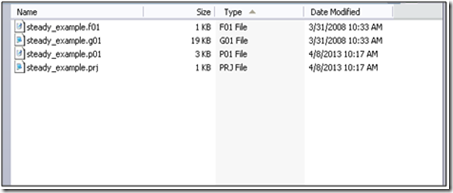
- .prj is the Project file. Contains current plan files, units and project description.
- .g01 is the Geometry file. Cross-sectional data, hydraulic structures and modeling approach data are stored here.
- .f01 is the Steady Flow file. Profile information, flow data and boundary conditions written in this file.
- For Unsteady Flow, .u01 is the flow file extension. This is where hydrographs and initial conditions are stored, as well as any user-defined flow options.
- For Quasi-Unsteady Flow (for a sediment analysis), .q01 is the flow file extension.
- .p01 is the Plan file. Contains a list of the associated input files, and all simulation options.
These are all text files and can be directly read and edited in a text editor. The following screenshot shows the input and output files after the steady flow model has been run. Note that some of these are only used by RAS as intermediate files during computations. 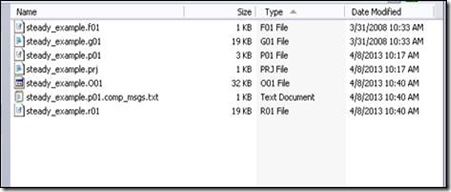
- .O01 is the Output file. Contains all of the computed results from the associated plan. This file is written in binary format and can only be read from the user interface.
- For Unsteady Flow, a .dss file is automatically generated as an output. This file contains time series data that is viewable by any program that can read dss files (typically HEC software).
- If your model links to a dss file for use as input data (e.g. inflow hydrographs, stage hydrographs, observed data, etc.), then that .dss file will be necessary to run the model and should be included in your group of files you send to a reviewer.
- .r01 is the Run file for steady flow analysis. Contains all of the necessary input data required for the RAS computational engine. The run file is created during the model simulation, and is not required to view final results.
- For Unsteady Flow, .x01 is the extension.
- .comp_msgs.txt is the Computational Message text file. Records the computational messages that pop up in the computation window. The messages file is not required to view final results, but can be useful in troubleshooting errors identified by RAS.
- .hyd01 is the Detailed Computational Level output file. This can be switched on in the Unsteady Flow Analysis window.
- .p01.rst is a Restart File (also called a Hot Start File, or Initial Conditions File). This option can be switched on by the user in the Output Control Options window. See the Hot Start post for more guidance.
For Unsteady Flow analysis, these files are categorized as “intermediate,” which means that they are not essential for running a model or viewing results, since they are recreated by RAS during run-time.
- .c01 is the Geometric Pre-Processor output file. Contains the hydraulic properties tables, rating curves, and family of rating curves for each cross-section, bridge, culvert, storage area, inline and lateral structure. This file is rewritten each time you change your geometry file.
- .b01 is the Boundary Condition file.
- .bco01 is the Unsteady Flow Log output file.
- .p01.blf is the Binary Log file.
- .IC.O01 is the Initial Conditions file.
If submitting your final model to a client or a reviewer, you will likely only send the necessary input files. Sending output files are optional, but will allow the reviewer to avoid rerunning the model on their end. Including the .c## files might be a good idea for larger models so that RAS can skip the pre-processing step. SEDIMENT ANALYSIS
- .S01 is the file extension for Sediment Data. This file contains flow data, boundary conditions, and sediment data.
- .SedCap01 is the extension for Sediment Transport Capacity data. When sediment transport computations are performed, RAS creates a set of intermediate files:
- .sed is the detailed sediment output file.
- .SedHeadXS01 is the header file for the cross section output.
- .SedXS01 is the cross section output file.
- .H01 is the Hydraulic Design data file.
- .H01.SiamInput is the SIAM Input Data file.
- .H01.SiamOutput is the SIAM Output Data file.
WATER QUALITY ANALYSIS
- .W01 is the file extension for Water Quality data. This file contains temperature boundary conditions, initial conditions, advection dispersion parameters and meteorological data. When water quality computations are performed, RAS creates a set of intermediate files;
- .bco is the water quality log file.
- .p01.wqrst01 is the water quality restart file.
- .color_scales is the file that contains the water quality color scale.
Remember that file extensions can be numbered from 01 to 99, and are assigned in the order that they are created.



Comments
The comments are closed.