Downstream Boundary-Normal Depth?
Written by Chris Goodell | January 4, 2010
Written by Chris Goodell, P.E., D. WRE
Copyright © RASModel.com. 2010. All rights reserved.Probably the most commonly used downstream boundary condition in both steady and unsteady RAS is the Normal Depth assumption. You make an assumption that your river flows under normal flow (uniform flow) conditions at the downstream boundary of your model. This allow you to provide an energy slope, and then RAS will automatically back-calculate the depth using Manning’s Equation. This method’s popularity stems from its ease of use and it’s semi dynamic properties (i.e. as the flow changes, so will the downstream boundary depth).
The most common question I get about using the Normal Depth option is what slope to use. To be true to Manning’s equation, the correct answer is the discrete energy slope at the downstream cross section. Well, without computing, this is impossible to come by, and in order to compute, you have to assume an energy slope. There are a few ways you can assume an energy slope for your downstream boundary:
- Measure the average bed slope of your stream in the profile plot.
 You can do this by holding the ctrl key and drawing a line to represent the average slope as shown above. The pop-up window gives you a dy/dx term, which is the slope.
- Measure the bed slope of the last two cross sections at the downstream boundary. This will better approximate the energy slope at the downstream boundary, but you can run into problems if your reach ends on a horizontal or adverse slope.
- Use a USGS Quad map or other contour file or terrain model of the reach downstream of your modeled reach. Measure the distance between the first two contour lines that cross the your stream.
Regardless of the method you use to get an energy slope, there will be some error associated with what you use. Besides the fact that you have to more-or-less guess at an energy slope, natural rivers and streams rarely-if ever exhibit uniform flow conditions. But, if we can manage the error associated with using normal depth, it can serve as a very convenient tool for estimating the downstream boundary condition.
To manage the error, I do a couple of things:
- Move the downstream boundary location as far away from my area of interest as possible. For example, if I’m working on a bridge hydraulics study, I try to get the downstream boundary at least 5 cross section widths downstream of the bridge.
- Perform a sensitivity study. Bracket a range of realistic energy slopes and then run both the high and low value. Plot both results on the profile plot and see where the solutions for both energy slopes converge. If it is below your area of interest than the boundary is far enough downstream. Caution…for you steep slope, make sure you do not force the results to critical depth by selecting a slope that is too steep.
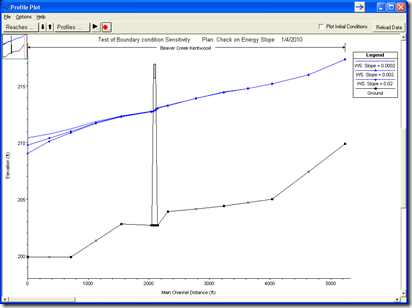
Here, you can see with the sensitivity study, the three profiles (with three different downstream boundary energy slopes) converge at the bridge. It might be wise to move the downstream boundary downstream a little further.

 You can do this by holding the ctrl key and drawing a line to represent the average slope as shown above. The pop-up window gives you a dy/dx term, which is the slope.

Comments
The comments are closed.