Now that the official release of HEC-RAS 5.0 is out with 2D capabilities, I’m getting a lot of questions about whether 1D or 2D (or 1D/2D combined) is the best way to set up a specific model. The answer is very simple. Like everything else…It depends! Fortunately, there are some guidelines.
1.The general rule of thumb is that if the length-to-width ratio is larger than 3:1, a 1D model can possibly be used; otherwise, a 2D model is needed (source: Desktop Review of 2D Hydraulic Modelling Packages, UK Environment Agency, 2009). For example, if a river reach is 10,000 m long and has a 100 m wide floodplain, the ratio is 100 to 1, so a 1D model is likely okay. For a river reach that is 10,000 m long but has a 5,000 m wide floodplain, the ratio is 2 to 1, so a 2D model will probably be needed.
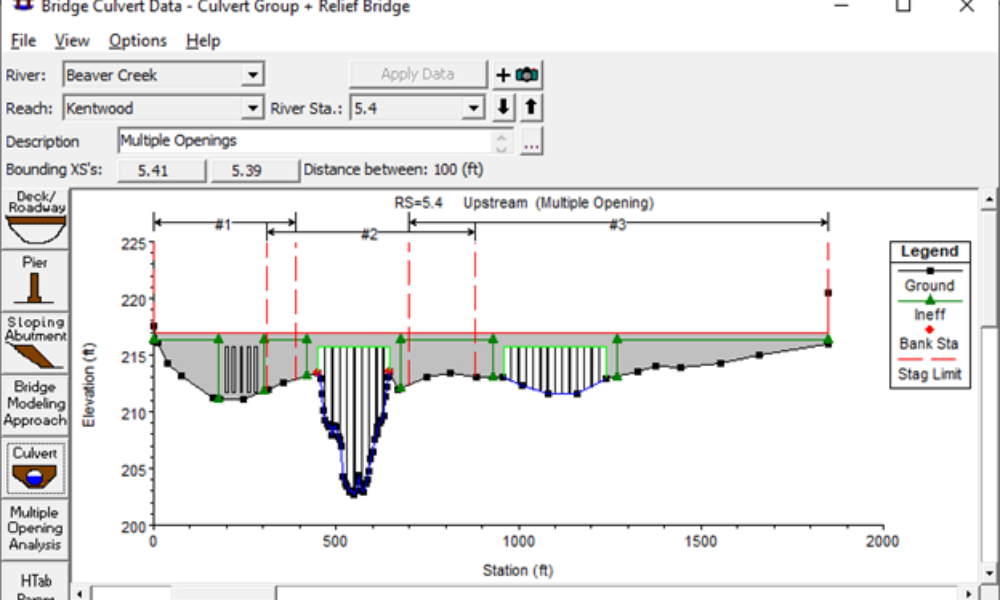
2.Features such as a narrow bridge crossing causes significant expansion/contraction are best modeled using 2D capabilities.
3.If knowing the flood patterns around buildings and other discrete features is important, a 2D model will be necessary.
4.Detailed animations showing floodwave progression in multiple directions at a local scale is best represented using a 2D model. If simple water surface elevation graphics are needed, both 1D and 2D models can be used to produce these results.
When will a 1D model be suitable?
1.Locations where flow isn’t required to ‘spread’ significantly (flow maintains primarily uni-directional flow patterns).
2.Well-defined channel/overbank systems (channel is bounded by steep slopes, constricting the lateral expansion of flows).
3.Simply-connected floodplains where flow in main channel is well connected to flow in the overbank and that flow in both is primarily uni-directional in nature.
4.When elevation data of only limited quality/quantity are available.
When is a 2D model usually preferable?
1.Anywhere flow is expected to spread
2.Urbanized Areas
3.Wide Floodplains
4.Downstream of Levee Breaks
5.Wetland Studies
6.Lake or Estuary Studies
7.Alluvial Fans
Other Considerations:
Like anything else, there is rarely a definitive answer to the subject question, rather a lot of gray area. Frequently, a model could be constructed in 1D or 2D and provide excellent answers either way. In this case, the experience of the modeler with 1D modeling or 2D modeling becomes very important. Someone who is very skilled at setting up a 1D model to represent 1- and 2-D conditions (a quasi-2D model) may end up with a much better model than if that same person tried to build a 2D model without much experience in 2D modeling. And vice-versa.
There are pluses and minuses to going purely 2D. First of all, if you can justify using Diffusion wave, a purely 2D model will most definitely be more stable and robust than a 1D or 1D/2D unsteady flow model. You’ll be surprised how easy it is to set up and run. Even if you do have to use Full Momentum, typically if your Courant Condition is well satisfied, the model will be more stable. With multiple streams arranged with complicated junctions and loops, the 2D version will do a much better job – especially around junctions and flow transfers from one stream to another. And you get to remove subjective modeling techniques like ineffective flow areas, levee markers, cross section orientation, etc. Some downsides to a fully 2D model are:
1.Run times. If your 2D area is very large and you have relatively small cells (i.e. a lot of cells), then run times can be long. By a lot of cells, I’m talking about 100,000 to 1 million or more. Making your model 2D in areas where you need detail and 1D everywhere else can help solve this problem.
2.Output. Getting output from 2D areas is a bit more cumbersome and limited. Still, you can get quite a bit of stuff out of your 2D areas, it just might take more time.
3.In version 5.0, there is no direct way to model pressure flow at bridges in a 2D area. Hopefully this will change for the next version.
4.Learning curve. Being new to 2D modeling, there will be some overhead just learning how to do it.
5.Your client may not be okay with it. Make sure your client is aware of the benefits of 2D modeling. There is generally a perception that 2D modeling is more expensive. This is not (should not) always be the case.
And remember…
Make everything as simple as possible, but not simpler.
-Albert Einstein (paraphrased)
For every complex problem there is an answer that is clear, simple, and wrong.



Comments
The comments are closed.